Quick Guide for Large Companies: What the New Carbon Footprint Regulation Requires and How to Prepare in 2026
(Updated March 19, 2026)
Law 11/2018, Royal Decree 214/2025, Directive (EU) 2026/470… legislation on carbon footprint reporting is changing rapidly and decisively.
In 2026, the carbon footprint has become a central element of corporate reporting. For large companies, measuring the footprint is no longer just a recommendation, but a requirement. The concept of carbon footprint has transcended the environmental sphere to become a market criterion that influences contracts, financing, and reputation. Therefore, in this article we will delve into the European and national regulatory framework on sustainability information and carbon footprint.
Carbon Footprint Regulatory Framework: Obligations in Force in 2026
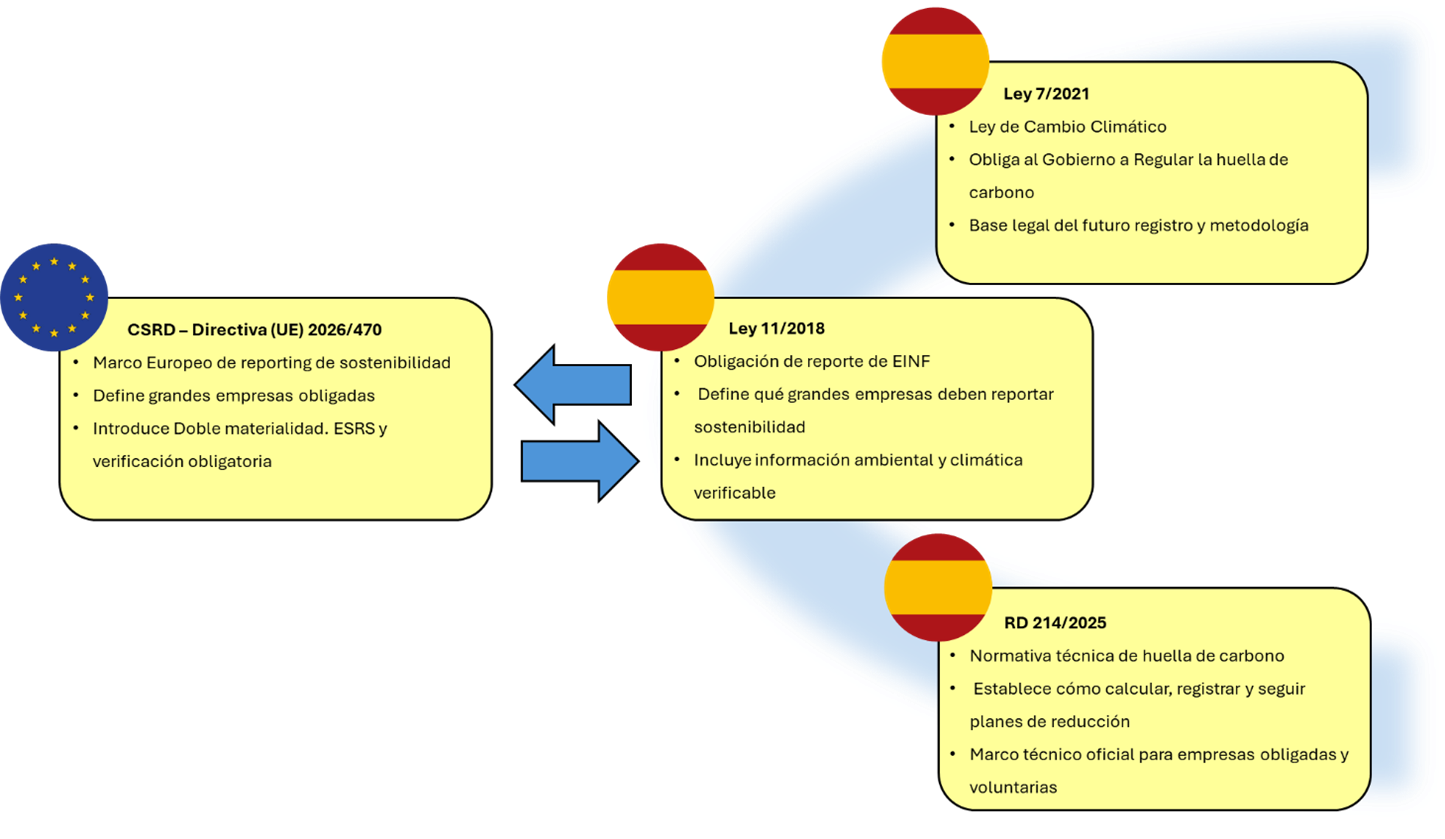
1. Law 7/2021: The Origin of the Climate Obligation
This is the Climate Change and Energy Transition Law, which constitutes the cornerstone at the national level.
Main function: Legally requires the Government to regulate the carbon footprint in Spain. In other words, it requires the Government to require.
Relevance: Establishes the necessary legal basis for the creation of the future registry and the definition of official calculation methodologies.
2. Law 11/2018: The Pillar of Non-Financial Reporting
Law 11/2018 is the regulation that determines who must report.
This is the law that requires large companies and public interest entities in Spain to prepare the so-called Non-Financial Information Statement (EINF).
What does this mean in practice?
- You must report on Greenhouse Gas (GHG) emissions, indicating your methodology.
- You must include detailed information on energy consumption (electricity and fuels), energy efficiency measures and use of renewable energy, as well as the current and foreseeable effects of the activity on the environment and the measures adopted to adapt to climate change.
- You must detail environmental risks and mitigation measures, including due diligence procedures to identify, prevent, and mitigate significant impacts.
- The report must be verified by an independent verification service provider, which means that the information must be traceable and technically sound.
- You must publish it and present it at the General Meeting and keep it accessible on the website for five years.
In other words: the carbon footprint is part of your legal obligations if you are large.
3. CSRD (Corporate Sustainability Reporting Directive) and Directive (EU) 2026/470: The Updated European Standard
The European CSRD directive is completely modernizing the way sustainability information is reported.
Why is it so important?
- It introduces the concept of double materiality: it not only requires you to report your environmental impacts, but also how these affect your financial results.
- It establishes European reporting standards (ESRS), which are adequate, comparable, and verifiable. Among other things, these ESRS (specifically ES1-8 in the most recent edition of the ESRS), require reporting emissions by Scopes, including Scope 3.
- It requires external verification of the reported information.
This means that:
- Your report must be complete, rigorous, transparent, and use recognized methodologies.
- All information must be verifiable and comparable.
The scope of this regulation has recently been revised by Directive (EU) 2026/470, published on February 24, 2026 and effective since March 18, 2026, with the objective of simplifying reporting and concentrating obligations on larger companies. Spain has 12 months to transpose this Directive into Spanish law and make it 100% applicable.
Okay, so far so good, right? We have discussed in both Law 11/2018 and the CSRD the obligation that large companies have, but what defines whether a company is large or not? It is one that, depending on the regulation, meets at least 2 of the following criteria:
| Criterio | Ley 11/2018 (vigente en 2026) | Directiva 2026/470 (UE) (esperando a su trasposición a España) |
|---|---|---|
| Empleados | >250 | >1.000 |
| Activos | >20M€ | >25M€ |
| Facturación | >40M€ | >450M€ |
This means that when a company enters this scope, its climate information becomes part of the sustainability report prepared in accordance with the ESRS and must be subject to mandatory external assurance.
Note: not only Large Companies are required under Law 11/2018, all Listed Companies are also required, whether large or small, because they are public interest entities, although this will change in the future with the transposition of Directive 2026/470.
4. Royal Decree 214/2025: The Technical and Operational Framework
This Royal Decree is not exclusively directed at large companies, but it regulates the Official Carbon Footprint Registry in Spain and therefore it is important to understand what it provides.
- It establishes the official framework for calculating and registering the carbon footprint and reduction plans.
- It defines technical requirements for registration and monitoring of the registered footprint.
- It allows companies to officially register their footprint and their reduction commitments. Although registration is not mandatory for all companies, it has become a reference for demonstrating technical rigor and transparency in emissions calculation.
Legislative Timeline
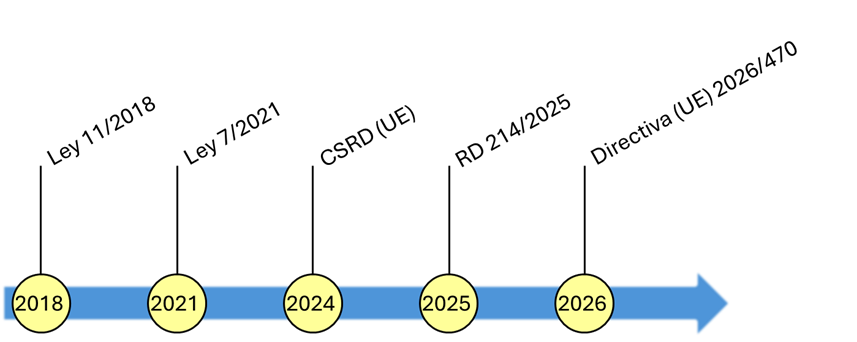
This regulatory framework draws a roadmap that evolves from the mere transparency of Law 11/2018 and the climate commitment of Law 7/2021, toward a much stricter accountability model. With the arrival of the CSRD and Directive (EU) 2026/470, transposed at the national level by RD 214/2025, companies move from reporting voluntarily to being legally required to manage their carbon footprint and sustainability risks throughout their value chain under unified European standards.
What Is Expected of You Right Now?
If your company is subject to these regulations, what the regulation requires is:
- Have your carbon footprint calculated (Scopes 1 and 2 at minimum)
- Have well-organized data and recognized methodologies
- Include, where applicable, objectives and reduction measures linked to identified impacts.
- Be able to respond to audits and verifications with evidence
- Publish and keep the information accessible in accordance with established transparency obligations.
As a summary, we have prepared a table that synthesizes the main obligations and requirements applicable today.
| SMEs | Large Companies and Listed Companies | ||
| RD 214/2025 | RD 214/2025 | Law 11/2018 and D.EU 2026/470 (EINF and CSRD) | |
| GHG Emissions Reporting | Voluntary | ||
| Scopes 1 and 2 | |||
| Scope 3 | Recommended | Recommended | |
| Reduction Plan | Information on Climate Policies and Objectives | ||
| External Verification | Mandatory only if there are process emissions and/or Scope 3 | ||
| Publication and Transparency | |||
| Calculation Methodology | Recognized methodologies (ISO 14064, GHG Protocol…) | Recognized methodologies (ISO 14064, GHG Protocol…) | Recognized methodologies (ISO 14064, GHG Protocol…) |
Conclusion
Today it is no longer enough to declare a commitment to sustainability: it is necessary to demonstrate it with solid and verifiable data.
For many large companies, the carbon footprint ceased to be a voluntary initiative long ago. The national and European regulatory framework requires structured information on emissions and energy, and the market demands transparency and consistency.
If you do not have clear metrics, a well-defined reduction plan, and technically consistent data, you may be assuming risks in tenders, financing, and relationships with strategic clients.
We help you turn this obligation into a competitive advantage, ensuring that your carbon footprint is correctly calculated, documented, and prepared to meet regulatory and market requirements. Contact us to prepare your Footprint Calculation and your Emissions Reduction Plan.