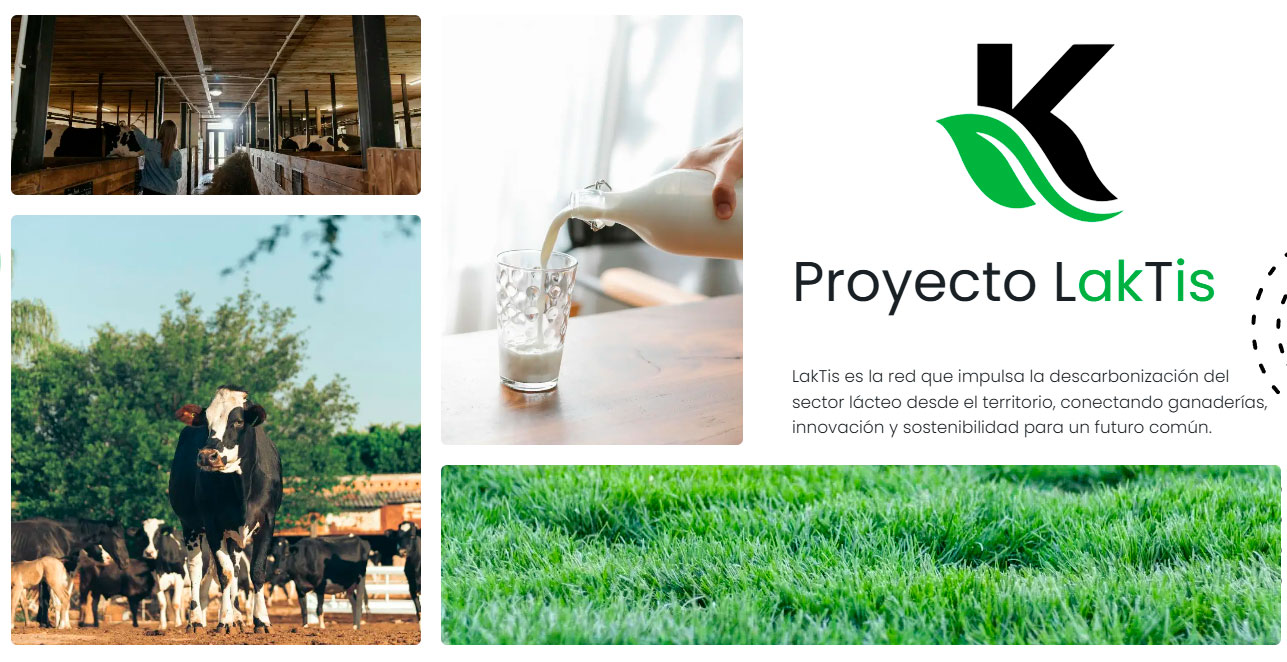
LakTis Project
LakTis is the network that drives the decarbonization of the dairy sector from the territory, connecting farms, innovation and sustainability
We design your tailored decarbonisation plan to comply with EU regulations, reduce your actual emissions and ensure your business competitiveness.
Decarbonisation is the process by which an organisation reduces its emissions of greenhouse gases (GHG) across its operations and value chain. Its goal is to decouple economic growth from climate impact through decisions based on data and rigorous inventories.
To develop an effective decarbonisation plan, it is useful to distinguish four key concepts:
• Emissions reduction: Prioritises the direct elimination of GHG through energy efficiency, process electrification and substitution of fossil fuels.
• Carbon offsetting: Finances external GHG absorption or avoidance projects, a complementary resource that does not replace the obligation to reduce.
• Neutrality: Acquiring as many carbon offsets as emissions generated by the organisation, regardless of whether a reduction plan exists or not.
• Net Zero: Requires reducing direct and indirect emissions to the minimum technically possible (around 90%) before neutralising unavoidable emissions with permanent removals.
A decarbonisation plan provides the metrics and action roadmap needed to transform the company’s production processes. To ensure its technical effectiveness, the decarbonisation strategy is divided into four fundamental phases:
To initiate any climate strategy, the first step is to measure your emissions through a complete GHG inventory under established standards such as ISO 14064 or GHG Protocol.
At this stage, emission sources are identified and quantified in Scope 1 (direct emissions from combustion, physical or chemical processes in production plants, or leaks), Scope 2 (indirect emissions from electricity consumed) and Scope 3 (emissions associated with the value chain, product use, services or transport, among others).
Once the inventory is complete, short-, medium- and long-term reduction targets are established aligned with climate science. Using frameworks such as the Science Based Targets initiative (SBTi) or Road to Zero ensures that the targets set by the company contribute quantitatively to limiting the global temperature increase to below 1.5°C compared to pre-industrial levels.
With quantitative objectives defined, a climate roadmap is designed detailing the specific measures the organisation must implement. This plan includes actions prioritised by cost, technical feasibility and impact on GHG reduction:
Decarbonisation is an ongoing process that requires constant monitoring to verify the effectiveness of the measures implemented.
Having a centralised carbon tracking tool facilitates periodic data updates, correction of deviations and generation of reliable reports ready for external audit processes.
European regulations have turned corporate sustainability into a legal and technical requirement based on verifiable data. The entry into force of EU directives requires organisations to provide transparency, unified metrics and realistic climate transition plans:
• CSRD (Corporate Sustainability Reporting Directive): Requires companies to report their impacts under ESRS standards. It requires detailing the climate transition plan and progress in reducing Scope 1, 2 and 3 emissions. It was revised and updated in 2026 by Directive (EU) 2026/470.
• EU Green Taxonomy: Classifies which economic activities are considered environmentally sustainable. It facilitates access to priority financing for organisations that demonstrate real contributions to climate change mitigation.
• National requirements: RD 214/2025 (Carbon Footprint Register) in Spain, BEGES (Bilan des Émissions de Gaz à Effet de Serre) in France, or SECR (Streamlined Energy and Carbon Reporting) in the United Kingdom are different national regulatory frameworks related to emissions calculation and reporting that many companies must comply with.
• Paris Agreement: International framework to achieve climate neutrality by mid-century. It is the global reference for aligning corporate strategy with the planet’s temperature containment objectives.
You have more details in our article on Regulation for Companies in Spain

LakTis is the network that drives the decarbonization of the dairy sector from the territory, connecting farms, innovation and sustainability

In collaboration with Holcim Spain, we developed a web tool for companies in the concrete sector, to help them calculate

SOLES Project – Modernization of Traditional Techniques in Madrid Vineyards
Adding {{itemName}} to cart
Added {{itemName}} to cart