CBAM, the Carbon Border Adjustment Mechanism: What It Is and How It Affects Importing Companies

How the Cost of Carbon Impacts Imports and What Companies Must Do
The Carbon Border Adjustment Mechanism, or CBAM (Carbon Border Adjustment Mechanism) is already a reality for companies importing into the European Union. Starting in 2026, carbon becomes a key factor in costs, supplier selection, and regulatory compliance. CBAM introduces new rules of the game that are already in motion. In this article, we explain what CBAM is and how to address it with confidence.
The CBAM is a mechanism that requires importers of certain products to pay a fee relative to the amount of carbon emitted at the source during the manufacturing of those imported goods. This instrument is established in Regulation (EU) 2023/956. Following its transitional phase (2023-2025), as of this year, 2026, the mechanism is now in its operational phase, with increasing requirements for companies and real economic consequences if not managed properly.
Why Does CBAM Exist?
The main objective of CBAM is to prevent carbon leakage: the relocation of production—and the associated greenhouse gas emissions—to countries with less stringent climate requirements.
In Europe, many industrial activities are subject to the European Union Emissions Trading System (EU ETS), which implies an economic cost for emitting CO₂ and other Greenhouse Gases (GHG). In contrast, in many third countries this cost is lower or nonexistent.
Without a corrective mechanism, this would create a clear incentive: produce outside the EU to reduce costs, even if this means higher global GHG emissions due to less stringent environmental regulations or less efficient technologies.
How CBAM Works in Practice
CBAM introduces a key principle:
Imported products must bear a cost for their emissions equivalent to what they would bear if they had been produced within the EU.
In this way:
- Competitive conditions are equalized between European and non-EU producers.
- The effectiveness of European climate policies is protected.
- Emissions reduction is incentivized beyond EU borders.
In practical terms, carbon becomes another economic variable in the import of certain products. In fact, this economic dimension is already tangible: shortly before this article was written, on April 7, 2026, an indicative value for the cost of CBAM certificates was published for the first time, set at €75.36/tCO₂. This amount, calculated based on the average EU ETS price, provides companies with a concrete basis for estimating the economic impact of carbon on their imports.
What Must Importing Companies Do in 2026?
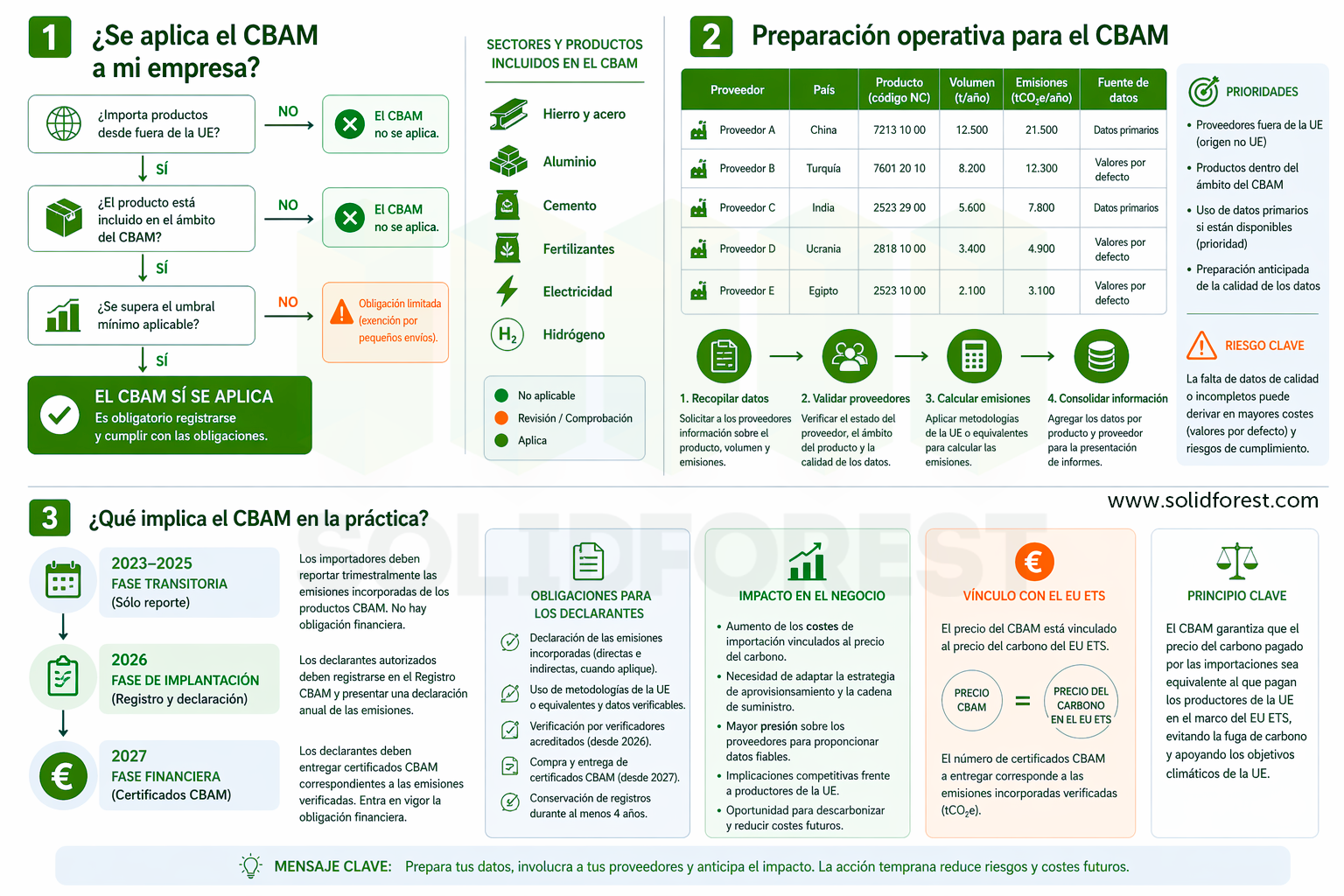
Starting this year, importing companies subject to CBAM must:
- Quantify the GHG emissions embedded in imported products.
- Register as authorized CBAM declarants.
- Submit periodic declarations in accordance with the regulation’s requirements.
- Prepare for the future acquisition of CBAM certificates equivalent to those emissions.
- Purchase CBAM certificates equivalent to those emissions. The first certificates will be issued as early as 2027 for imports made in 2026.
The mechanism initially applies to sectors with high carbon intensity, such as:
- Iron and steel
- Aluminum
- Cement
- Fertilizers
- Electricity
- Hydrogen
Not all products containing these materials are subject to CBAM. Many complex processed products are currently excluded. If you have doubts about whether the products your company imports are subject to CBAM, please contact us.
Beyond formal compliance, CBAM has significant impacts on:
- Procurement costs.
- Supplier selection and evaluation.
- The need for transparency and traceability in the supply chain.
In many cases, it also means changing the way companies interact with international suppliers, who must now provide reliable and verifiable emissions data.
It is important to note that CBAM affects not only importing companies in the EU, but also producers outside the Union who export to this market. While importers must manage the carbon cost associated with their purchases, exporters see how their emissions directly influence the competitiveness of their products. In this context, data quality and traceability become a key factor in the commercial relationship between both parties.
How to Address CBAM Effectively
To manage CBAM effectively, it is essential to:
- Determine whether the products imported by your company fall within the scope of the mechanism.
- Prepare robust internal processes for the collection, calculation, and management of emissions data.
Addressing it reactively, with incomplete data or default values, usually translates into higher costs and reduced response capacity. In contrast, a structured approach allows you to anticipate impacts and make more informed decisions.
Emissions Calculation as a Strategic Element
Within the CBAM framework, emissions calculation ceases to be an isolated technical exercise and becomes a key management element.
The focus is on embedded emissions per product (embedded emissions), whose composition depends on the type of good and its regulatory classification. In many cases, the main weight falls on direct emissions from the production process. In others, especially in complex products or those using precursors (intermediate inputs), indirect emissions must also be considered, according to applicable methodologies.
This involves:
- Correctly defining process boundaries.
- Applying appropriate calculation or measurement methodologies.
- Ensuring data traceability and consistency, which is especially critical in complex supply chains.
Furthermore, the economic impact is clear: the use of default values or non-verifiable data can significantly increase the cost associated with purchasing CBAM certificates.
How Solid Forest Helps
At Solid Forest we help companies manage CBAM in a rigorous, structured, and business-oriented manner.
Our approach goes beyond mere compliance and includes:
- Accurate and regulation-compliant calculation of emissions associated with imported products.
- Development of auditable data architectures, prepared for inspections and future requirements.
- Support in managing information with international suppliers, improving data quality from the source.
- Identification of decarbonization opportunities in the supply chain, with real impact on costs.
This enables our clients to:
- Comply with CBAM with confidence and control.
- Anticipate the economic impact of the mechanism.
- Make better decisions in purchasing and procurement.
- Optimize, in the medium and long term, the costs associated with CBAM certificates.
Shall We Discuss How to Address CBAM in Your Company?
CBAM is already having a real impact on importing companies, both from a regulatory and economic standpoint. Having a solid approach from the outset makes the difference between merely complying and managing the mechanism efficiently and strategically.
At Solid Forest, we support our clients throughout the entire process, from initial scope analysis to emissions calculation, data management with suppliers, and optimization of costs associated with CBAM certificates. If you want to understand how CBAM affects your supply chain and what levers you can activate to reduce risks and costs, we are here to help. Contact us and let’s design the best strategy together.